Category: Blog

  • January 2021 FEATURED Real Estate Broker

    January 2021 FEATURED Real Estate Broker

    REBAP Global City Featured Broker of the Month –January 2021

    ATTY. JERICO D. SALENGA

    REA, REB, Lawyer

    CRB Jerico D. Salenga as friends call him “Jeric”, is a very active and dynamic person. He is a person that you can approach and is willing to accommodate your concern whether it be business or legal matters. He is active in both professions as Real Estate service practitioners and a Lawyer.


    Educational Background:

    CRB Jeric took his Bachelor Laws in San Beda College of Alabang – School of Law and graduated in 2013. He is holding office at 5/F Pasig Revolving Tower, Marketing Avenue, San Nicolas, Pasig, City. His practice includes pleadings, petitions, commentaries, letters, legal contracts, among others.

    CRB Jeric further his knowledge to reinforce his Law practice and took the Real Estate Brokers and Real Estate Appraiser Board exams in 2015 and passed on the year.


    Professional Legal Experience:

    CRB Jeric’s legal experiences have been in the legal limelight since 2004 and his experience of the profession includes being a paralegal with the Office of the Solicitor General in Makati City in 2005; Legal Aide  with the Pasay City Hall Jail Precinct in 2004;  Attorney III for the Civil Aviation Authority of the Philippines, Pasay, 2016-2018; Associate Council for J.P. Jimenez Law Office, 2015-2016; Associate Council for Hechanova Bugay Vilchez Andaya-Ricadio, Makati , 2014-2015 and he is currently the Founding Manager of Salenga Law firm.

    For CRB Jeric, the legal Profession can be further reinforced by a more exciting and profitable business and profession thus, he decided to become a Real Estate Broker in 2015. He believes that Real Estate is an exciting business and profession and when he combined these with his legal practice, he instantly found out the benefits and the excitement of engaging in both. Here, he experienced endless transaction on various types of real estate dealings and considered each of it as very rewarding.

    REBAP City Global is proud to have you on board CRB Atty Jerico “Jeric” Salenga. Welcome and enjoy the comradery!!


  • January 2021 Featured Real Estate Broker

    January 2021 Featured Real Estate Broker

    Richard Thaddeus Carvajal, Chartered MCSI, REB, RFP

    Richard Thaddeus Carvajal,  is an Alumnus of the University of Oxford in United Kingdom where he studied Real Estate and Finance. He graduated with a Master’s Degree in Real Estate and Investments with honors.

    His experience in portfolio management involves a decade of handling international clients and high net worth investors specifically in the services of investment consultancy, valuation and capital markets.

    Currently, he is the Chief Executive Officer of PHILGEMS Realty Corp. and holds the following licenses; A Registered Financial Planner, Duly Licensed Real Estate Broker and a Chartered Member of the Chartered Institute of Securities & Investments in London and an Associate of the Chartered Institute of Royal Surveyors (RICS) .

    He is currently a finance columnist for Business Mirror and Manila Times, a MoneySense Magazine Writer and a keynote speaker conducting various seminars around the globe. His expertise has also been featured in different radio and TV shows in ABS CBN such as Bottomline with Boy Abunda

    Richard is also a College Professor for BS Real Estate Management in iAcademy. He teaches subjects such as Investment Analysis, Global Business, Real Estate Finance, Brokerage, Marketing and Economics.

    He is also the author of the best-selling books entitled “The Real Pro” – becoming the next Real Property Expert and “The Millennionaire”- becoming the next Millennial Millionaire

    In 2019 He was recognized by the prestigious Asia CEO Awards as the Young Leader of the Year- Circle of Excellence Awardee and 2020 Lamudi Award’s People’s Choice, Best Broker of the Year.


  • Inheritance Tax vs. Estate Tax

    Inheritance Tax vs. Estate Tax

    What is Inheritance Tax and Estate Tax
    Philippine Train Law

    There’s an old saying that’s been used countless times in movies and TV. The line goes something like, “There are two things you cannot escape in life: Death and Taxes”. In some countries, this is even referred to (colloquially) as “Death Taxes”. Definitely dark humor, but in reality, it has a ring of truth to it.

    A large number of people work very hard to secure a good future for their loved ones and provide for all their needs. They may also hope to leave some kind of lasting legacy when the inevitable end comes. It can take many forms such as real estate, money, personal belongings of value (e.g. family heirlooms, jewelry, paintings, cars), or various assets that can be passed on to loved ones. This is all fine and good. Until the time comes for the lawful heirs to come claim their inheritance. This is when taxes rear their ugly head (as if the passing of a loved one wasn’t hard enough).

    Anyone who has inherited something from someone who passed away by way of being included in a will may be required to pay inheritance tax. But before we can proceed, we need to define first what is meant by “estate”. Someone’s estate can include property, as well as everything else of value the deceased party owned at the time of death.


    Inheritance Tax vs Estate Tax

    Simply put, inheritance tax is a tax imposed by the government on the beneficiary of the inheritance (i.e. The person(s) receiving the asset or estate). This is in no way tax levied on the property itself, but rather, it is a tax on the transmission (or turn-over) of the estate of the deceased to one or more heirs. One of the most common questions that arise is “who pays the inheritance tax?”. Some countries put the sole responsibility of paying the inheritance tax on the lawful heirs, while the estate tax is paid out from the estate’s funds. However, in the Philippines, they are one and the same. From this point forward, we will be using Inheritance Tax and Estate Tax interchangeably since they really mean the same thing under Philippine law.

    For example, if several beneficiaries are the recipient of a particular property (let’s say an office building), inheritance or estate tax will be computed for each beneficiary. This means that each beneficiary is responsible for paying for their own tax.

    The estate tax return must be filed with the Bureau of Internal Revenue (BIR) if the gross value of the estate (consisting of registered property, vehicles, shares of stock, jewelry, money, etc.) has a gross value of more than Php200,000. That being said, it may actually make more sense to distribute inheritance before the time of death (which can sometimes be tricky, because death doesn’t abide by anyone’s schedule)


    Non-resident inheritance tax

    If any of the heirs are non-residents (i.e. migrate to another country), they also need to file an estate tax return. If the executor of the will lives in the Philippines, the estate tax return can be filed with an authorized agent bank of the specific Revenue District Office (RDO) where the executor lives.  However, in case there is no executor in the Philippines, for example if the deceased was not a Philippine resident, then the tax return should be filed under the jurisdiction of RDO No. 39 South Quezon City.


    How is inheritance tax computed?

    So now we delve into the computation of the inheritance tax. The inheritance tax is computed against the net value of the assets included in the estate. The net value is sometimes referred to as the “gross estate”, which refers to all property including real property, personal property, tangible property (such as bonds or shares of stock), or intangible property (such as patents, trademarks or copyrights). Also. This is computed using the Fair Market Value (FMV) at the time of death. FMV is the reasonable price at which one could sell the estate to an interested buyer.

    Since we already discussed non-resident inheritance tax, let’s also consider the possibility that the deceased wasn’t living in the Philippines (a non-resident, or not a Philippine citizen) at the time of death. Only the part of the gross estate that is situated in the Philippines is considered taxable.

    This tax must be settled within six (6) months from the date of death before distribution of the inheritance to the beneficiaries can proceed. Otherwise, the beneficiaries may face penalties, unless an extension is granted by the commissioner. If you could prove to the commissioner that payment by the due date would impose undue hardship on the estate or any of the heirs, the due date could be extended up to 5 years if the case is settled through courts, and up to 2 years, if handled extrajudicially. In the Philippines, a graduated tax rate determines inheritance taxes. Estates with a net value of less than Php 200,000 are exempted from paying inheritance tax while those valued at a higher amount may be required to pay a tax rate of anywhere from 5% up to 20%. In general, late payments incur a 25% initial penalty and accrue 20% annual interest on the amount. If any fraud is involved, the amount leaps to 50%.


    Is there any way to reduce the amount of inheritance tax?

    This is another common question asked by beneficiaries of an estate. The most common method is to apply as many deductions on the inheritance tax as possible.  This will lower the FMV of the estate, which can help put the value of the estate at a lower tax tier or threshold. It is always a good idea to examine which deductions can be applied to the estate. Below is a short list (i.e. not comprehensive) of deductions that might be applicable:


    Deduction What is this?
    ELIT (Expenses, Losses, Indebtedness, and Taxes) Funeral expenses, other claims against the estate, judicial expenses of interstate proceedings, unpaid mortgages, claims of the deceased against insolvent individuals
    Transfers for public use The amount of all bequests, legacies, devises or transfers to or for the use of the Philippine Government, or any political subdivision thereof, for exclusively public purposes
    Family Home The lower number between the family home’s FMV or Php 1 million, and the family home must be certified by the barangay captain of the locality
    Standard deduction The amount of Php 1 million
    Medical expenses Expenses incurred by the deceased within a year prior to their death, which has to be supported with receipts, for a maximum deduction of Php 500,000.


    Estate Tax Amnesty

    One of the most recent developments regarding tax amnesty at the time of this writing is the Tax Amnesty Act signed by President Rodrigo Duterte. This provides a 2-year period for taxpayers to settle estate tax obligations through a tax relief over properties with outstanding tax estate liabilities. The Tax Amnesty Act started on June 15, 2019, and will cover the unpaid estate taxes of any decedent who passed away on or before December 31, 2017.

    Those with unsettled estate taxes starting from January 2018 to date can still benefit from the Estate Tax Amnesty through the amendments made under the TRAIN Law. It states that a tax rate of 6% will be imposed on the total net estate value of the decedent.

    Useful Links:

    Tax Amnesty Act – https://www.officialgazette.gov.ph/2019/02/14/republic-act-no-11213/

    TRAIN Law – https://www.bir.gov.ph/index.php/train.html


  • Real Estate 101: What is Inheritance Tax and Estate Tax? What’s the Difference?


    Real Estate 101:  What is Inheritance Tax and Estate Tax? What’s the Difference?

    Real Estate 101: What is Inheritance Tax and Estate Tax? What’s the Difference?


    There’s an old saying that’s been used countless times in movies and TV. The line goes something like, “There are two things you cannot escape in life: Death and Taxes”. In some countries, this is even referred to (colloquially) as “Death Taxes”. Definitely dark humor, but in reality, it has a ring of truth to it.

    A large number of people work very hard to secure a good future for their loved ones and provide for all their needs. They may also hope to leave some kind of lasting legacy when the inevitable end comes. It can take many forms such as real estate, money, personal belongings of value (e.g. family heirlooms, jewelry, paintings, cars), or various assets that can be passed on to loved ones. This is all fine and good. Until the time comes for the lawful heirs to come claim their inheritance. This is when taxes rear their ugly head (as if the passing of a loved one wasn’t hard enough).

    Anyone who has inherited something from someone who passed away by way of being included in a will may be required to pay inheritance tax. But before we can proceed, we need to define first what is meant by “estate”. Someone’s estate can include property, as well as everything else of value the deceased party owned at the time of death.


    Inheritance Tax vs Estate Tax

    Simply put, inheritance tax is a tax imposed by the government on the beneficiary of the inheritance (i.e. The person(s) receiving the asset or estate). This is in no way tax levied on the property itself, but rather, it is a tax on the transmission (or turn-over) of the estate of the deceased to one or more heirs. One of the most common questions that arise is “who pays the inheritance tax?”. Some countries put the sole responsibility of paying the inheritance tax on the lawful heirs, while the estate tax is paid out from the estate’s funds. However, in the Philippines, they are one and the same. From this point forward, we will be using Inheritance Tax and Estate Tax interchangeably since they really mean the same thing under Philippine law.

    For example, if several beneficiaries are the recipient of a particular property (let’s say an office building), inheritance or estate tax will be computed for each beneficiary. This means that each beneficiary is responsible for paying for their own tax.

    The estate tax return must be filed with the Bureau of Internal Revenue (BIR) if the gross value of the estate (consisting of registered property, vehicles, shares of stock, jewelry, money, etc.) has a gross value of more than Php200,000. That being said, it may actually make more sense to distribute inheritance before the time of death (which can sometimes be tricky, because death doesn’t abide by anyone’s schedule)


    Non-resident inheritance tax

    If any of the heirs are non-residents (i.e. migrate to another country), they also need to file an estate tax return. If the executor of the will lives in the Philippines, the estate tax return can be filed with an authorized agent bank of the specific Revenue District Office (RDO) where the executor lives.  However, in case there is no executor in the Philippines, for example if the deceased was not a Philippine resident, then the tax return should be filed under the jurisdiction of RDO No. 39 South Quezon City.


    How is inheritance tax computed?

    So now we delve into the computation of the inheritance tax. The inheritance tax is computed against the net value of the assets included in the estate. The net value is sometimes referred to as the “gross estate”, which refers to all property including real property, personal property, tangible property (such as bonds or shares of stock), or intangible property (such as patents, trademarks or copyrights). Also. This is computed using the Fair Market Value (FMV) at the time of death. FMV is the reasonable price at which one could sell the estate to an interested buyer.

    Since we already discussed non-resident inheritance tax, let’s also consider the possibility that the deceased wasn’t living in the Philippines (a non-resident, or not a Philippine citizen) at the time of death. Only the part of the gross estate that is situated in the Philippines is considered taxable.

    This tax must be settled within six (6) months from the date of death before distribution of the inheritance to the beneficiaries can proceed. Otherwise, the beneficiaries may face penalties, unless an extension is granted by the commissioner. If you could prove to the commissioner that payment by the due date would impose undue hardship on the estate or any of the heirs, the due date could be extended up to 5 years if the case is settled through courts, and up to 2 years, if handled extrajudicially. In the Philippines, a graduated tax rate determines inheritance taxes. Estates with a net value of less than Php 200,000 are exempted from paying inheritance tax while those valued at a higher amount may be required to pay a tax rate of anywhere from 5% up to 20%. In general, late payments incur a 25% initial penalty and accrue 20% annual interest on the amount. If any fraud is involved, the amount leaps to 50%.


    Is there any way to reduce the amount of inheritance tax?

    This is another common question asked by beneficiaries of an estate. The most common method is to apply as many deductions on the inheritance tax as possible.  This will lower the FMV of the estate, which can help put the value of the estate at a lower tax tier or threshold. It is always a good idea to examine which deductions can be applied to the estate. Below is a short list (i.e. not comprehensive) of deductions that might be applicable:


    Deduction What is this?
    ELIT (Expenses, Losses, Indebtedness, and Taxes) Funeral expenses, other claims against the estate, judicial expenses of interstate proceedings, unpaid mortgages, claims of the deceased against insolvent individuals
    Transfers for public use The amount of all bequests, legacies, devises or transfers to or for the use of the Philippine Government, or any political subdivision thereof, for exclusively public purposes
    Family Home The lower number between the family home’s FMV or Php 1 million, and the family home must be certified by the barangay captain of the locality
    Standard deduction The amount of Php 1 million
    Medical expenses Expenses incurred by the deceased within a year prior to their death, which has to be supported with receipts, for a maximum deduction of Php 500,000.


    Estate Tax Amnesty

    One of the most recent developments regarding tax amnesty at the time of this writing is the Tax Amnesty Act signed by President Rodrigo Duterte. This provides a 2-year period for taxpayers to settle estate tax obligations through a tax relief over properties with outstanding tax estate liabilities. The Tax Amnesty Act started on June 15, 2019, and will cover the unpaid estate taxes of any decedent who passed away on or before December 31, 2017.

    Those with unsettled estate taxes starting from January 2018 to date can still benefit from the Estate Tax Amnesty through the amendments made under the TRAIN Law. It states that a tax rate of 6% will be imposed on the total net estate value of the decedent.

    Useful Links:

    Tax Amnesty Act – https://www.officialgazette.gov.ph/2019/02/14/republic-act-no-11213/

    TRAIN Law – https://www.bir.gov.ph/index.php/train.html


    The post Real Estate 101: What is Inheritance Tax and Estate Tax? What’s the Difference? appeared first on PHILREP Realty Corp..

  • How much does it cost to transfer a land title in the Philippines?

    How much does it cost to transfer a land title in the Philippines?

    We will be bringing you a series of articles that discuss commonly asked questions regarding real estate in general.  One of the most commonly asked questions we encounter whenever we conduct trainings and orientation seminars for those interested to get into the real estate industry is “How much does it cost to transfer the land title”?


    Buying property is generally considered one of the biggest steps a person can take in life, typically due to the large amount involved. But unlike other purchases that one can make, real estate is not something you can normally have by paying for in one quick transaction. Along with the property’s price are other expenses that come as part of the purchase.  In this respect, the most important is perhaps the cost to transfer the land title.


    For buyers or sellers, transferring the land title can prove to be a challenging experience. The paperwork involved and the fees that need to be paid can be daunting for first timers.  With that said, let’s start off by discussing the fees associated with purchasing property.  Let’s start off with the cost of transferring the land title.  This fee needs to be paid whenever property is purchased, sold, donated or inherited. Having the land title under your name is very important as it serves as your proof of ownership of the property, regardless if you are a buyer, a donee or an heir. The absence of this document can lead to the ownership of your property being disputed. Therefore, it is imperative that you ensure the correct processing of this document.  And one of the ways to ensure this is to pay all the required fees and taxes.


    The following are the fees and taxes that you need to be aware of.  The amount of these fees and taxes are based on how much the property cost at the time of the transaction or transfer:


    • Any Unpaid Real Estate Taxes due – always check if the property you are buying has any unpaid real estate taxes particularly if you are buying property directly from the owner
    • Capital Gains Tax (CGT) – this is computed as 6% of the selling price specified on the Deed of Sale or the Zonal value, whichever amount is higher
    • Withholding Tax – this only applies when the seller of the property is a corporation (e.g. a land Developer)
    • Transfer Tax (Local Treasurer’s Office) – this is tax imposed on the sale, barter, or any other method of transferring of the ownership or title of real property, at the maximum rate of 50% of 1 percent of a property’s worth (in the case of cities and municipalities within Metro Manila, this is 75% of 1 percent)
    • Transfer Tax (BIR) – Transfer taxes may also be owed to the Bureau of Internal Revenue. If the property was donated, the Transfer Tax is in the form of Donor’s Tax. If the property was transferred via inheritance, this is in the form of estate tax.
    • Documentary Stamp Tax – this is commonly set at 1.5 percent of the selling price, orr the zonal value or fair market value, whichever is higher.
    • Registration Fee – commonly set at 0.25 percent of the selling price, or zonal value or fair market value, whichever is higher.
    • Commission of the Agent and/or Broker
    • Incidental and miscellaneous expenses – typically any expense incurred in the registration process, such as notary fees, etc.


    The total amount of all these fees and taxes is the cost of transferring a land title. As you can see, all these fees and taxes can quickly add up.


    Now, closely related to this topic is another question often asked immediately afterwards: “Who should shoulder the Land Title Transfer expenses?”


    The common practice in the Philippines is that the seller is responsible for the following:


    • Capital Gains Tax
    • Withholding Taxes
    • Any unpaid real estate taxes that are due
    • Commission of the Agent and/or Broker assisting in the completion of the transaction


    The buyer on the other hand, takes care of the following:


    • Documentary Stamps
    • Transfer Taxes
    • Registration Fees
    • Incidentals and miscellaneous expenses incurred in the registration process


    This arrangement is considered standard practice. But in other cases, the buyer and seller can also mutually agree on who pays for what during the negotiation period, when the Deed of Sale (a.k.a. Deed of Absolute Sale) has not been signed yet.  This document shows the legal transfer of real estate property ownership and is submitted to the Registry of Deeds for filing after the buyer pays the Documentary stamps, transfer tax and registration fees for the aforementioned Land Title Transfer.


    As you can see, the entire process and everything involved can prove to be very burdensome to both buyer and seller.  Since most buyers are willing to pay millions to buy property, it is sometimes worth it to engage a company that specializes in land title transfers in order to take the burden away from the buyer and seller.  This also ensures that the transfer is done correctly and completely.


  • Real-Estate 101: The cost of transferring a land title in the Philippines

    Buy land, they aren’t making anymore of it. – Mark Twain

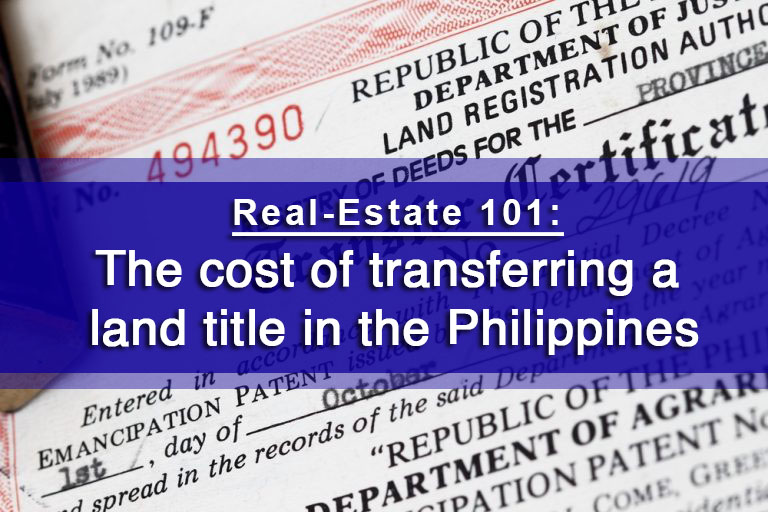
    The cost of transferring a land title in the Philippines


    We will be bringing you a series of articles that discuss commonly asked questions regarding real estate in general.  One of the most commonly asked questions we encounter whenever we conduct trainings and orientation seminars for those interested to get into the real estate industry is “How much does it cost to transfer the land title”?


    Buying property is generally considered one of the biggest steps a person can take in life, typically due to the large amount involved. But unlike other purchases that one can make, real estate is not something you can normally have by paying for in one quick transaction. Along with the property’s price are other expenses that come as part of the purchase.  In this respect, the most important is perhaps the cost to transfer the land title.


    For buyers or sellers, transferring the land title can prove to be a challenging experience. The paperwork involved and the fees that need to be paid can be daunting for first timers.  With that said, let’s start off by discussing the fees associated with purchasing property.  Let’s start off with the cost of transferring the land title.  This fee needs to be paid whenever property is purchased, sold, donated or inherited. Having the land title under your name is very important as it serves as your proof of ownership of the property, regardless if you are a buyer, a donee or an heir. The absence of this document can lead to the ownership of your property being disputed. Therefore, it is imperative that you ensure the correct processing of this document.  And one of the ways to ensure this is to pay all the required fees and taxes.


    The following are the fees and taxes that you need to be aware of.  The amount of these fees and taxes are based on how much the property cost at the time of the transaction or transfer:


    • Any Unpaid Real Estate Taxes due – always check if the property you are buying has any unpaid real estate taxes particularly if you are buying property directly from the owner
    • Capital Gains Tax (CGT) – this is computed as 6% of the selling price specified on the Deed of Sale or the Zonal value, whichever amount is higher
    • Withholding Tax – this only applies when the seller of the property is a corporation (e.g. a land Developer)
    • Transfer Tax (Local Treasurer’s Office) – this is tax imposed on the sale, barter, or any other method of transferring of the ownership or title of real property, at the maximum rate of 50% of 1 percent of a property’s worth (in the case of cities and municipalities within Metro Manila, this is 75% of 1 percent)
    • Transfer Tax (BIR) – Transfer taxes may also be owed to the Bureau of Internal Revenue. If the property was donated, the Transfer Tax is in the form of Donor’s Tax. If the property was transferred via inheritance, this is in the form of estate tax.
    • Documentary Stamp Tax – this is commonly set at 1.5 percent of the selling price, or the zonal value or fair market value, whichever is higher.
    • Registration Fee – commonly set at 0.25 percent of the selling price, or zonal value or fair market value, whichever is higher.
    • Commission of the Agent and/or Broker
    • Incidental and miscellaneous expenses – typically any expense incurred in the registration process, such as notary fees, etc.


    The total amount of all these fees and taxes is the cost of transferring a land title. As you can see, all these fees and taxes can quickly add up.


    Now, closely related to this topic is another question often asked immediately afterwards: “Who should shoulder the Land Title Transfer expenses?”


    The common practice in the Philippines is that the seller is responsible for the following:


    • Capital Gains Tax
    • Withholding Taxes
    • Any unpaid real estate taxes that are due
    • Commission of the Agent and/or Broker assisting in the completion of the transaction


    The buyer on the other hand, takes care of the following:


    • Documentary Stamps
    • Transfer Taxes
    • Registration Fees
    • Incidentals and miscellaneous expenses incurred in the registration process


    This arrangement is considered standard practice. But in other cases, the buyer and seller can also mutually agree on who pays for what during the negotiation period, when the Deed of Sale (a.k.a. Deed of Absolute Sale) has not been signed yet.  This document shows the legal transfer of real estate property ownership and is submitted to the Registry of Deeds for filing after the buyer pays the Documentary stamps, transfer tax and registration fees for the aforementioned Land Title Transfer.


    As you can see, the entire process and everything involved can prove to be very burdensome to both buyer and seller.  Since most buyers are willing to pay millions to buy property, it is sometimes worth it to engage a company that specializes in land title transfers in order to take the burden away from the buyer and seller.  This also ensures that the transfer is done correctly and completely.


    The post Real-Estate 101: The cost of transferring a land title in the Philippines appeared first on PHILREP Realty Corp..

  • BEWARE THE SIM SWAP SCAM!


    With the rise in cybersecurity threats and data breaches, companies have been advising people to turn on multi-factor authentication (MFA).  This basically involves using more than one method of authenticating a user.


    For example, a website may require you to enter your username and password, then send an SMS message to the mobile phone number you specified during registration.  The code in the SMS message is randomly generated hence the term One-Time-Password (OTP). You need to enter the OTP in order for you to gain access to the website.


    Likewise, mobile banking apps on your phone also implement MFA by requiring you to enter your username and password, then also send you the OTP (usually on first time access).  They also normally require the use of OTP for transaction that involve payments, fund transfers, or any changes to your user account info.


    Sounds like a very secure way of doing transactions right?  Someone would need to steal your phone (or your SIM) in order to obtain your OTP in order to impersonate you and perform transactions in your name.  This is basically a form of IDENTITY THEFT.


    Scammers and crooks have always been busy trying to find ways of defeating the latest security measures.  The latest wave of identity theft goes by several names. Some call it the SIM swap scam, others call it SIM splitting fraud.  But whatever name you prefer to call it, here is some of the common ways the scam is committed:


    • Someone claiming to be a Telco representative offers you a SIM upgrade. All you need to do is turn in your old SIM card so they can replace it with a new SIM card with upgraded features.  Unless you’re actually at the Telco branch talking to the customer sales representative sitting behind the desk, do not surrender your SIM!  The moment you surrender your SIM card, these crooks now have access to your OTP and can start attempting to change your user account information so they can eventually make fraudulent transactions.


    • Another way this scam is performed is with the help of someone within the Telco company itself. There have been stories of Telco staff participating (either willingly or unwillingly) to illegally provide duplicate SIM cards to criminals organizations and scammers.


    • Some may even go to the Telco branch and claim to be you and report your SIM card as missing and request for a replacement SIM card.


    Regardless of the method, the end result can be devastating for you and your family.  Your entire life savings or retirement fund can be wiped out should you fall for this scam!


    To combat this kind of criminal activity and fraud, the following tips may prove to be a life-saver:


    • Needless to say, ALWAYS turn on MFA on all your mobile devices
    • If available on your device, use biometric (i.e. fingerprint or facial recognition) authentication
    • Regularly change your password (every 90 days is a good interval)
    • Always use long complex passwords that only you can remember. If you love eating ice cream, an example of complex password can be “Ic3Cre@mSunda3!”
    • If you don’t like remember many passwords, you can use a password manager so that it will take care of generating complex and randomized passwords for each website you visit, and you will only need to remember the master password. Don’t take our word for it, check out this list of recommended password managers:  https://tinyurl.com/y7vuowqa


    At the end of the day, knowledge about these scams and vigilance on our part will be our weapons against these criminal elements that want to steal your hard-earned money!

    The post BEWARE THE SIM SWAP SCAM! appeared first on PHILREP Realty Corp..

  • Leveraging Technology in Real Estate Service

    Leveraging Technology in Real Estate Service

    Leveraging Technology in Real Estate Service
    Leveraging Technology in Real Estate Service


    If you are trying to get back on your feet amidst the GCQ, then here are a few ways to get clients in the new normal!


    Build A Website

    The new normal requires social distancing, and with non-essential businesses temporarily closed due to the government mandate for self-quarantine measures to be in effect, having a website is one of the best ways to get your listings out.  We know this can be a bit daunting for most people, so we’ll post more articles to help you get started building your website, so stay tuned!  For now, let’s concentrate on the advantages of having your own real-estate website:


    1.) Accessibility

    Once you have your website up and running, your properties can be viewed by endless potential clients from all over the world. It is readily accessible, and it can be easily shared online. The properties you sell can be seen conveniently and gain interest from various people.  But what if getting your website up and running is currently not feasible right now? What other options do you have to get the word out online that you’re in the real-estate business?  The next best thing is to leverage something that is already there and already accessed by millions of people worldwide, and that is Social Media! Don’t worry, we’ll get to that in a minute.


    2.) Credibility

    With a website, you can build your online credibility and even establish your brand, if you’re inclined to do so. Building credibility is very important for Brokers and Agents alike. Having good credibility builds trust with your client and can help you land good deals and in turn, potential get more buyers through positive word-of-mouth.

    To establish a good business and personal relationship with your clients, it is advisable that you start focusing on specific projects or areas.  Having a focus project or area allows you to concentrate on learning all about that specific project or area.  The whole point of this is to become very familiar with the project to the point where you can call yourself a subject matter expert (SME).  Being an SME means you can talk about a project in detail with your potential clients and answer their questions with confidence.  This builds up your image with your buyers because this shows them that you know exactly what you are talking about.


    3.) Management

    With your own website, you have complete control over what you post, and when you post it. This means you now have the ability to keep all your listings up to date.  An updated inventory gives you the advantage of finding the right home for your client. This can be very advantageous if you are focusing on high-end properties.  Depending on the number of properties you advertise, this can be also pose a challenge as well.


    Use Social Media

    Having your own website out of the question for now?  You can use social media as your platform!  It’s quick and easy to set up!

    1.) Advertisements

    Take advantage of the various free social media sites such as Twitter, Facebook, LinkedIn, and Instagram to advertise your listings and garner attention. These platforms are often used by the general public, and when properly utilized, can spread your name or your company’s name in a very short period of time. You also have the option of boosting your posts in social media.  On most social media platforms, boosting your post is quite affordable, but your mileage may vary of course.  It is always better to build your online reputation first by creating useful and informative posts on these platforms so that people start to take notice of you and hopefully share your posts with their circle of friends and acquaintances.  Think of this as a positive word-of-mouth endorsement.


    2.) Relevancy

    Social media apps are available to almost everyone with Internet access, so it helps you stay relevant in the public’s eye. Using these sites can help you expand your reach in advertising your properties and also get your name out to interested clients. It is important to let your presence be known because the more people that know you, the more they think about your business.  Try to keep your posts always relevant to real-estate so that your social media profile because better associated with the real-estate industry.


    3.) Branding

    If you want to be able to differentiate yourself from the rest of your competitors, you should establish your brand. This is a great way to establish name-recall and show your specialization to your clients. You can brand yourself as a property consultant, but that also makes you responsible for keeping yourself up to date on everything affecting real estate. This means always reading the latest news and trends from reputable sources. Doing this gives your clients the confidence that they are getting the best advice on their real estate concerns.


    Learn Video/Photo Editing and Production

    You need to be competitive online.  It is inevitable that you need to learn and understand what makes a video or picture effective in attracting potential buyers.  It’s a given that potential clients will want to see what you’re selling. After all, everyone wants to see what they’re paying for!


    1.) Visual Appeal

    It is important for listings to be appealing to clients. It either creates a good or bad impression on them. Often buyers tend to not stick around a property which looks dark, cluttered, and unorganized. It also shows how the quality of the estate, whether the condition is fit for them to live in or not. It pays to learn more about the basics of taking an appealing photo of real-estate properties.  We will tackle this in future articles.


    2.) Perspective

    Basic knowledge on selecting a good visual perspective of a property will help make your property more appealing to potential clients.  It will also help make your listing more visually informative, providing your buyer with a better understanding of the estate.


    3.) Image and Video size

    This is a bit on the technical side, but you want to keep the file size of your images and videos small enough so they load quickly but still retain a decent visual quality so they don’t come out as blurry or pixelated. We will be posting more on this topic soon, so stay tuned for our future articles!


    Knowledge on Your Property


     1.) Be Knowledgeable

    This is very important in the field of Real Estate.  The last person a buyer wants to talk to is someone who doesn’t have the basic information readily available.  Having extensive knowledge on the property you are selling can help clients make decisions faster (i.e. close the sale). Also, being able to answer their questions quickly and effectively shows your seriousness in helping them make an informed decision. You might now end up closing the deal now, but this will leave a positive impression on your client and can potentially result in a future sale or referral.


    2.) Customer Care

    It is important to assume that you are not the only one a buyer is talking with. Most clients shop around first in order to compare offers from properties that they are interested in. Potential clients often go for the agent or broker who provides the best knowledge and customer care. Show the customer you are not just in it for the commission, but you are providing them a valuable service by acting as an investment adviser of sorts so they can make the best decision with their money.


    3.) Landing the Deal

    If you have great familiarity and knowledge on your properties, you can cater to your buyer’s needs effectively. You can also provide alternatives or better options to fit their tastes when looking through listings, thus helping them find their dream home or investment opportunity.


    “Dahil sa new normal, kailangan natin gumawa ng paraan para maka-adapt sa ating bagong sitwasyon. Wala sa edad ‘yan, lahat tayo puede matuto, basta palagi natin isipin na kakayanin natin.”

  • What is Mortgage Redemption Insurance?

    What is Mortgage Redemption Insurance?

    Mortgage Redemption Insurance or  MRI is a type of Life Insurance required by Banks and other Lending Institutions when you apply for a Home Loan. An MRI pays off the outstanding mortgage balance of the borrower in case of his or her death or total disability.


    While there are those who do not see the need for an MRI, as it supposedly just adds to the money that needs to be shelled out. The purpose of an MRI is two-fold: First, it protects the bank – the MRI guarantees that the bank will be paid back the amount that was lent out. Therefore, the bank or lender does not have to sequester the house from the borrower’s surviving family. Secondly, it protects the borrower’s surviving family – the MRI helps settle the outstanding house loan amount so that the borrower’s surviving family does not have to worry about how to pay off the outstanding loan amount.


    Whenever you make a significant investment, you need to protect it via insurance. To be clear, MRI is not like fire insurance which is typically an add-on to your property insurance, or insurance that includes protection from Acts-of-God. Hopefully, You now have a better understanding of MRI and how it is different from fire insurance.

  • REBAP Global City Chapter conducts Corporate Social Responsibility

    REBAP Global City Chapter conducts Corporate Social Responsibility

    .
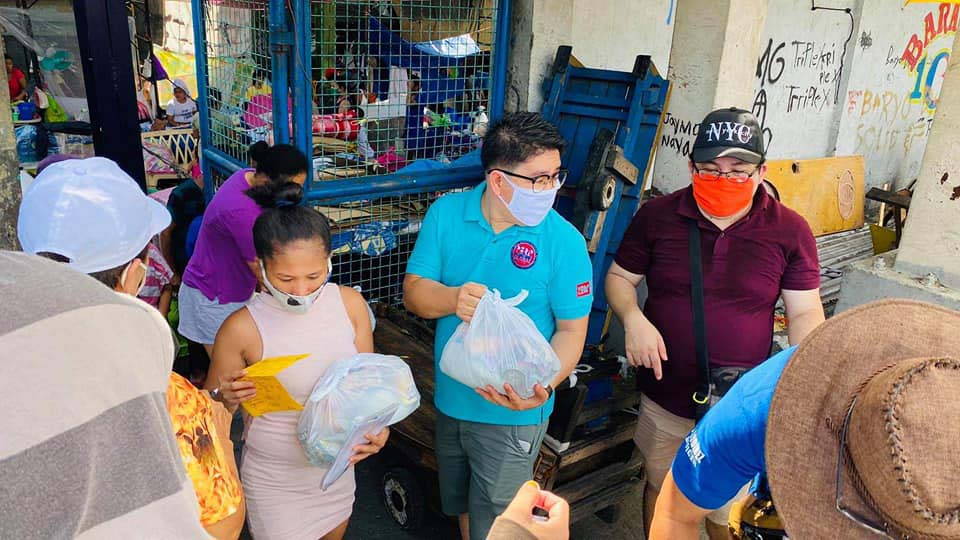
    May 2, 2020 Saturday, REBAP GLOBAL CITY conducted another Corporate Social Responsibility (CSR) – Bayanihan Disaster Relief Operation and this time the organization has chosen only the 152 families out of 1,055 total affected families of Brgy. 105, Zone 8, District 1, Road 10, particularly GK Compound, Happy Land, Tondo Manila. Portion of this area was hit by fire last April 18, 2020 around 7 o’clock in the morning. Amidst the on- going COVID 19, the residents are facing another tragedy. Responding to their call, REBAP Global City immediately initiated this activity for the purpose duly called for through its Board/ Officers considering that for the month of May 2020, no officers or monthly general membership meeting will be conducted. Thus to make this month active knowing that Enhanced Community Quarantine in NCR is still enforced , the organization decided to shift the regular conduct of monthly meeting into a meaningful, timely and relevant cause – the corporate social responsibility aspect of the organization to do philanthropic mission in times of crisis.

    The group of REBAP Global City Officer headed by Its Chapter President CRB Isidro R. Montalban, Jr and members CRB Atty. Jay M. Rallang and CRB Rod Magat proceeded to Brgy. Happy Land to physically distribute the relief goods to each affected family with the help of the local volunteers. The organization is wishing that all affected families be accommodated as much as possible. It was indeed a great shared experience for us to do front lining activity, such as this.

    This CSR will not be made possible without the participation and goodwill coming from the following donors and volunteers:

    REBAP Global City Officers and CRB Family
    Chapter President CRB ISIDRO MONTALBAN JR
    Chapter Adviser CRB Norie Datar
    VP-Internal CRB Doah Sto Tomas
    CRB Emm Garingalao
    CRB Atty. Jay Rallang
    CRB Rod Magat
    Ms. Irin Rebollo
    Brgy. 176 Kagawad Pia Estayo
    Ms. Emmalyn A. Sacdalan
    MRV Prime Appraisal and Property Management Corporation
    PHILREP Realty Corporation
    Magdalo Volunter President of the Deepest Area – Manila Chapter – Mr. Alan Godinez
    Magdalo Manila Chapter Secretary – Ms. Helen Bermejo
    Chairwoman Elenita G. Reyes, the Brgy. Treasurer and volunteers.
    Residents of Happy Land Brgy 105 Tondo

    REBAP Global City is thanking everyone. And to all the affected residents, just stay safe, stay strong, and stay healthy all the time. Keep the faith and spirit alive!